

I’m in a reading slump. It’s very difficult for me to sit down and read anything for an extended period of time. This isn’t because it’s hard to focus–which I think is the case for some people–but because there’s so much noise out there that it’s hard for me to make the decision to set aside the time to sit and read. As a business owner and a parent of four children, it’s also very easy for me to choose to do other things that feel more pressing, not least because silence is important for deep reading.
It doesn’t help that I’m disgusted with the current state of literature. I haven’t been reading much classic literature lately, because if you want to write commercial fiction, you should mostly (though not exclusively) read contemporaries. I read widely in sci-fi and fantasy, and the quality of literature is declining (though there are some pleasant surprises, here and here).
All of this has meant a reading slump. But it’s more than just a reading slump: it’s hard for me to concentrate in general. I used to be able to concentrate as needed, but now, I am defaulting more and more toward distracting behaviors. Cal Newport talks about this–the default of reaching for your phone when you’re bored, turning on the latest podcast whenever you have free time or chores to do. And Cal Newport isn’t alone–people have talked ad infinitum about the addictive nature of devices and social networks and how we’re unable to think as deeply as we used to. That isn’t quite what I’m talking about.
I’m talking about how we, as a society, have reached a saturation point with the amount of information and noise out there. I’m talking about how we are experiencing an inability to be able to parse out information coming at us if we don’t actively block it.
There is SO MUCH information out there. A lot of it is good and valuable and, in small doses, can be quite transformative.
But I can’t even attend to good content anymore, because there’s just too much. My brain simply stops. And when I myself am teaching and giving talks, my thought process limps. I don’t think this is cognitive decline or age. I think it’s a function of where we are as a society, especially in the US at this moment.
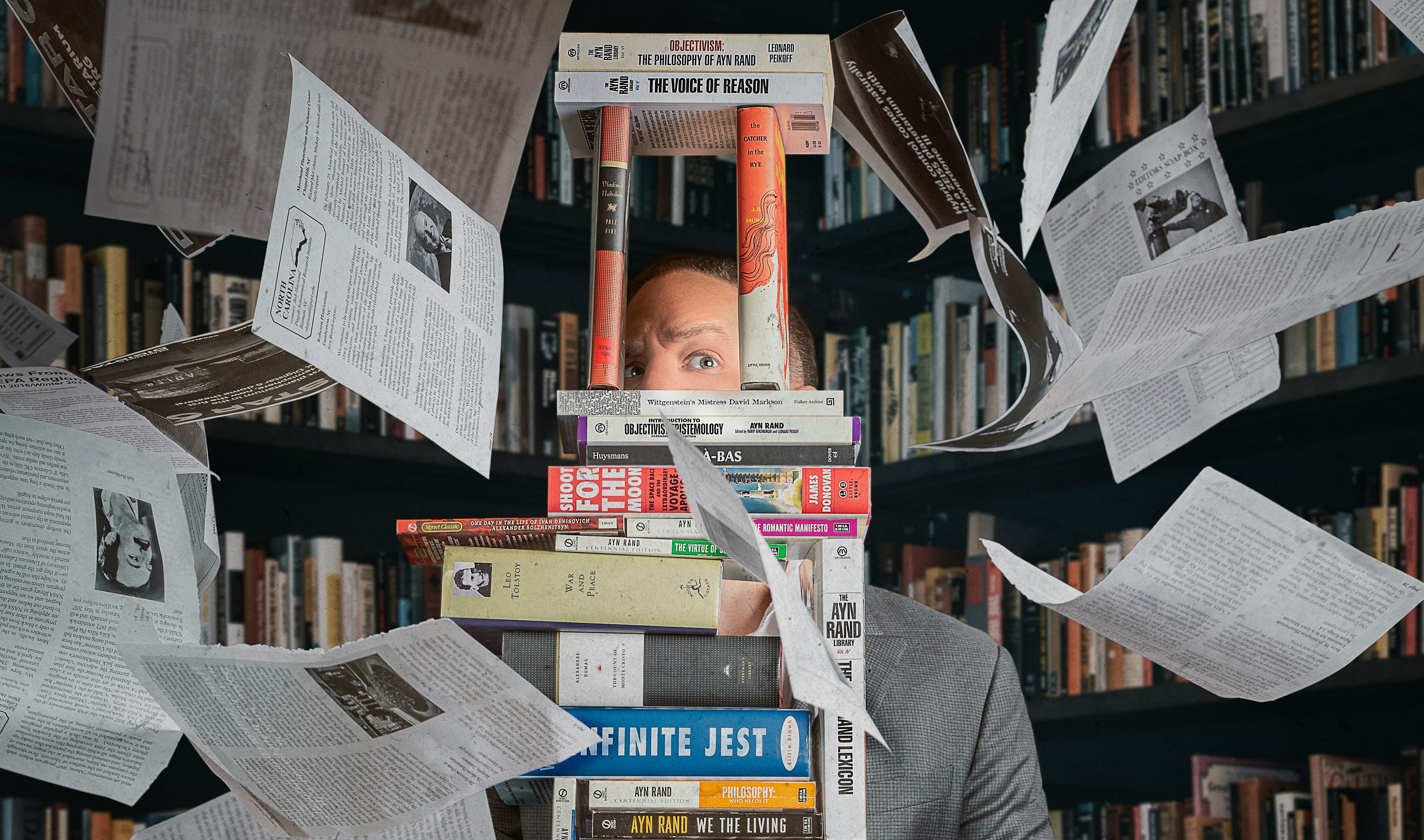
The Breaking Point
I think the election is a marker of this. With the embrace of total media control by the whitehouse, we’re being flooded with constantly shifting points of information and no breathing space. This is causing people to have very serious physiological issues parsing information.
The old ways of reaching people have stopped working. Social media is no longer social, which is obvious to me now in terms not just of feelings–which people have been talking about for a while–but of hard numbers. At most, we’re pressing “like” buttons and moving on. On Substack, everyone is feeling the brain rot that’s coming from way too many sources of input. Instagram is nothing but a steady stream of reels. Facebook is nothing but a steady stream of ads. Every day now, I’m getting extremely well-crafted ChatGPT messages from non-existent book promotions specialists wanting to bring me readers in the tens of thousands. They have photographs and websites, but it’s all a gimmick. It isn’t real.
Because of this, we just don’t have the mental or emotional bandwidth to engage online. (I actually don’t think this is a bad thing if it drives us to engage emotionally with people in our own house and local community, but we must recognize what’s happening if we are to keep our personhood.)
The 4 Stages of Education According to Andrew Kern
Recently, I spoke at the CiRCE regional conference in Texas, where Andrew Kern gave a wonderful lecture on the pursuit of happiness. He has a system that outlines the four stages of education:
- The first is the moment of illumination, the “aha” moment;
- The second is arranging all things according to the template of the tabernacle (a tripartite structure with a narthex, a nave, and a sacred space);
- The third is the discipline of the senses to be able to discern the beautiful and the ugly. We’re seeing a lack of discernment in the senses constantly right now, and the holy fathers spoke a lot about how important this is to cultivate, because without it, you can be overpowered by emotion into delusion.
This discipline to discern is almost impossible if you are living a primarily online life. I would not have said this a year ago, but today, it is true. There’s too much information, even good information, and simply no way for a human mind to be able to parse everything and decide, without training, what should be allowed in and what shouldn’t. This is hard, and it requires distance between the self and the source.

When I spoke with Paul Kingsnorth, the conversation really shook me in a very good way: I think he is a prophet and has a deep intuition, and the things he has been warning us about are happening in ways that are not conspiratorial but obvious to anyone who is paying any attention (the latest instances being the commitment of open AI and other large language models to include artificially-generated pornography and the new app called SORA, which allows you to create AI-generated videos with a prompt, leading people to waste lots of time looking at stupid AI slop they create themselves);
- Fourth is personal transformation, the renewing of the mind (more properly translated as “nous”) spoken of in Romans 12. This renewal of the nous means that emotions and thoughts are one, united in the wholeness of the individual person. Today, we’re seeing a complete dislocation of these two, with the thoughts being unable to descend into the heart. It is literally impossible for this descent to happen with the way people are engaging with the internet right now.
I Can Still Produce Quality Work, but Is That Enough?
This has really made me worry.
I can force myself to write. In terms of output measured in words on paper, 2025 has been the most productive year for me in a long time. And the quality of my work isn’t suffering either. Feedback from my mentor and contest submissions show my writing is stronger than ever.
Output is there.
Quality is there.
But I’m not really there. My thinking is not there. My presence is not there.
There is something seriously wrong with the way people are relating to one another and to their technology. This is simply a fact. I see it in myself, and I see it in others who are not the kinds of people who live inside their devices. These are intelligent thinkers and creatives, and they just can’t deal with the information overload anymore. Nobody can. It’s now beyond our ability to parse. Even experts can’t tell what’s real and what’s not when it comes to AI-generated videos, and the same is becoming true of AI-generated text. If you’re already overwhelmed by the amount of information you’re allowing in, you’re not going to be able to tell what’s real and what’s fake.
I’m not intrinsically opposed to the new technology as such, but what I am seeing is that the way people are relating to this technology is now beyond the pale. There’s no way we can do this in a sustainable manner. There needs to be a completely new way of approaching it, which for many of us will necessitate distance, either for a short time or forever, to assess how to relate to the technology in a way that is good–not just for business–but for the human person. If the human person is not being fed, the business is going to dry up anyway.
So What Do We Do?
For myself, I plan to do a deep dive on how best to approach this problem. My patrons live all over the world. Speaking to them online is wonderful, and I’m not saying I’m going to stop. But I do recognize that the source, power, and inspiration for my work come from in-person communications. I felt that at the CiRCE conference, where I had some of the most heart-filling interactions in about fifteen years with people I love and respect. I need to put the emphasis there if I am to continue sharing the outpouring of that with you all digitally.
There will be a movement of people who will separate themselves from the current technologies and embrace a counter-culture movement of analogue-only. I don’t plan to go all the way there, but I do plan to go in that direction.
This means that, for my personal author business, I want to explore having a better mode of communication that is analogue, in addition to livestream appearances. Some creative professionals are using the idea of the “anti-net” for quarterly physical newsletters. I’m reading Wonder Confronts Certainty, and this is what Dostoevsky did. He had a publication called “The Writer’s Notebook” that was his place to try out ideas, report on current events, write historical essays, etc. It wasn’t particularly successful financially, but people still read it today. The fact that what was essentially a marketing periodical is still read today is remarkable!
I’m considering how to do more of this type of thing, be it a tangible newsletter or more in-person events. In fact, one of the reasons we created WBW Press was to have a trusted source of new fiction so that readers don’t have to wade through slop to find the gems.
And you? Have you felt yourself reaching that same saturation point? If so, what choices will you make?