

Writers like J.R.R. Tolkien and Fyodor Dostoevsky, both of whom wrote genre fiction through the lens of their Christian faith, have inspired generations of readers and writers, myself included. Yet there’s an inherent risk in trying to communicate one’s experience with the transcendent in fiction: no one wants to be preached at.
How can fiction honestly communicate the encounters with the divine that we experience in our lives every day without being preachy? Which stories do the best not merely at entertaining us but also at conveying something profound about what it means to be human, about communion with the divine, about making meaning in a universe that seems sometimes to offer an abundance and sometimes to offer nothing at all?
I speak a lot about how fantasy and fairy tales are the genres most suited to telling difficult truths about the human condition. But these days, something strange is happening: secular sci-fi seems to be producing the best stories!

Where It Went Wrong
Secular Fantasy Is Getting Off-Track
In 1977, Star Wars (which is space opera, by the way, not sci-fi) succeeded because it was patterned after the good vs. evil Absolute Story (albeit in a diluted manner). I would have expected, then, that Disney Plus’s Obi-Wan Kenobi would have leaned into this. In fact, the set-up could not have been more perfect for a true redemption arc since the story starts with Obi-Wan Kenobi having lost hope in the ideals of a society that was built to uphold something virtuous.
But for Obi-Wan Kenobi to get to the point where he eventually mentors Luke, he ought to have undergone a deep transformation in which he became the wise mentor who is completely sure about himself as a wielder of the Jedi vision and can therefore pass down his knowledge to the next generation. The natural story to tell, then, would have been a hero’s journey that took Kenobi through the dark night of the soul before reaching a eucatastrophe that involves a return home as a hero bearing a transformative power received as a boon.
But instead, maybe due to the political turmoil that reduced the talent pool in Hollywood a few years back, we got a story that couldn’t access the deep transformation fantasy is capable of. We got a stupid Kenobi who could do nothing but whine and make mistakes and maybe not even be the main character. It was a lost opportunity to allow Kenobi a deep, heart-warming, hero’s journey of personal transformation, a transformation inherently reflective of and tied to the divine without being overt. That’s what fantasy is so good at doing, but for some reason, our modern fantasy stories just aren’t doing it. So what is?

Writing the Divine in Religiously-Informed Sci-Fi
In his guide How to Write Science Fiction and Fantasy, Orson Scott Card says that sci-fi differs from fantasy in that it cannot include angels, demons, trolls, goblins, or any manifestation of the divine.
In his own Homecoming series, which is a thinly veiled allegory or fictionalization of The Book of Mormon, Orson Scott Card gets around this rule of telling a religious story in a sci-fi setting by making god into a computer, a computer that has the ability to control the minds of those on planet Harmony. As we discover later, this computer was made by man in order to prevent mankind from ever making nuclear weapons and destroying itself as it destroyed planet earth 40 million years prior.
This set-up has all kinds of issues. When man creates “god,” why would anyone follow “god’s” dictates as though he were divine? Yet the computer god does call the main character, Nafai, to become a prophetic figure who leads the complacent away from decadence into the promised land. Nafai’s obedience to the man-made god becomes particularly problematic when the god computer tells Nafai that he must kill someone for the good of his mission. Nafai is disgusted by the idea, particularly because the computer tells him to kill the man at a moment when the man is passed out after a night of drinking and is completely at his mercy. Spoiler: Nafai does it.
Although the story is powerfully-written, it just doesn’t work: the story never gives a satisfactory answer to the question: why obey a computer created by man?
A technological approach to the divine in stories, at least in this instance, is clearly not the answer.
The Answer: Suggesting the Divine Good through Its Opposite
Interestingly enough, the answer I found when writing religiously-informed fantasy is exactly the same answer successfully embodied in today’s secular sci-fi.
Writing the Divine in Religious Fantasy
When I first started writing my Raven Son series, (skip ahead to the next section if you don’t want spoilers!), the character Adonais was supposed to be a fantasy version of the Christian God. Adonais had made a covenant with a nation that was supposed to ensure a kind of ideal by which humanity might transcend its own fallen nature. That was my intention.
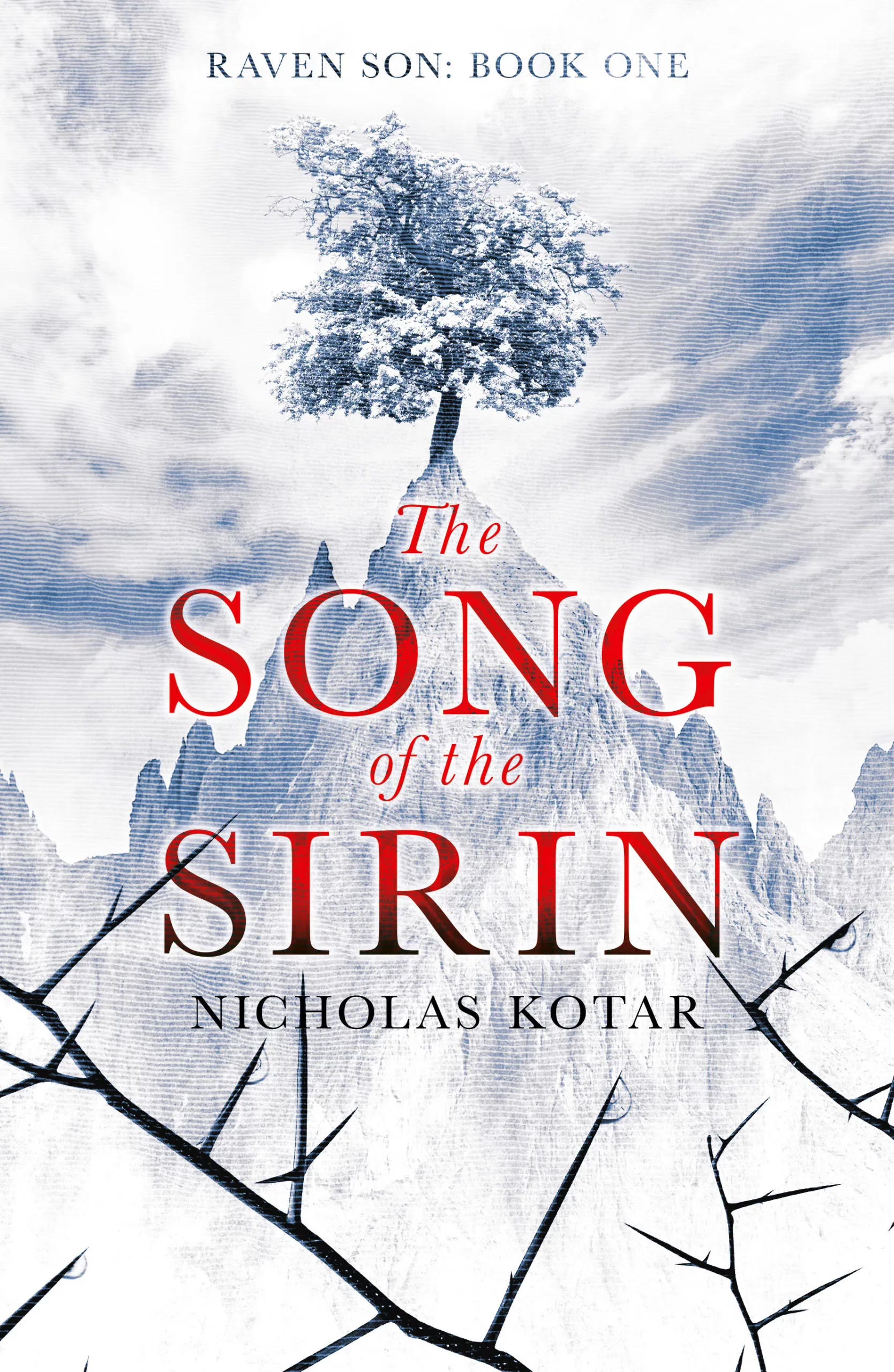
But it’s very difficult to write about a covenantal relationship between God and his chosen people without writing a direct allegory. I avoided allegory in book one, The Song of the Sirin, primarily because Adonais is an “offscreen” character and because the book focuses on the waning of the covenant and the memory of the people’s glorious past. In that sense, the book is not so much a paraphrasing of Scripture as it is a story about the decline of civilization.
But as I continued writing the series, the problem became very real. The forces of evil become embodied characters who move the story forward in obvious ways. This creates a problem: how do you demonstrate a counterbalance, showing an embodied good deity, without writing something hokey and preachy? I didn’t know how to answer that question, and the further I got into book three, The Heart of the World, the more it became unclear to me how the good could manifest itself in a compelling manner.
Then it dawned on me that my subconscious was providing an answer my conscious mind hadn’t caught up with yet: you demonstrate the reality of the good by leaning into the portrayal of its opposite. When that happened, I realized that Adonais was actually not God. So when a form of the divine finally shows up in book five, it is not at all a preachy moment, but rather a fulfillment of a kind of promise that was given in book three by the revelation of the strength of the evil character.
The Transcendent in Secular Sci-Fi
And this principle–knowing the good by leaning into the portrayal of its opposite–is exactly where secular sci-fi is excelling.
I was absolutely flabbergasted watching the first four episodes of Raised by Wolves on HBO Max. On the surface, this should be a show I hate. It’s about an anti-utopia being built by androids as a haven for atheists. The show follows two children raised by android parents who are essentially Adam and Eve figures. The children are taken to a place that is as anti-Garden of Eden as you can imagine–there’s very little plant life, and at first there seems to be no animal life either; when animal life does appear, it’s predatory.

This is an anti-parable of what it means to be human with reference to the divine. It is very much a secular tale. My sense is that the creators are on the side of the atheists, but what happens in this supposed paradise? Nothing goes right! All the children die except one (a chosen one fantasy trope), conflict and predation are endemic, and violence supplants utopia. Everything in the story suggests that this version of potential paradise for atheists is doomed from the start. It cannot work.
We see this break down especially in the relationship between the android parents. The father figure is subordinate to the mother figure (an Old Testament inversion), with the result that the dominating mother becomes a devouring mother. Of course, the wild mother must kill to protect her young, but how does she know when she must be a nurturer instead of a protector? Since she has no community or hierarchy to lean on, she can’t tell the difference. It might as well be an allegory for a therapeutic-first culture. When the dominating force in a relationship is motherly, it can be much more frightening than a tyrannical masculine force. In fact, we find out later that the feminine android is a repurposed killing machine!
And of course, given this set up, the child has a natural desire to pray, a natural desire for the transcendent, a natural desire for a connection with a power other than his mother’s.
Unfortunately, despite its popularity, the show was canceled, so we won’t see how it ends. But even in its first few episodes, this secular parable about the possibility of an atheist paradise did more to show the reality of the transcendent than either the secular fantasy Obi-Wan Kenobi show or the religious sci-fi allegory of Homecoming. (I will warn you that I had to stop watching Raised by Wolves after episode 4 because the darkness was unrelenting, but the storytelling instincts of everything I watched were spot-on.)
Conclusion
I’ve often talked about fantasy’s ability to delve into man’s encounter with the unknown, or what we might call the wildness at the edge, whereas science fiction has always been more about the “what ifs” of human capability in a purely materialistic form.
But now, secular sci-fi is doing what fantasy should be doing, but better. It’s the secular, anti-Christian storytellers who are doing the best job right now of giving us stories of man’s encounter with the divine.
Why is this? I have a few theories, but I don’t know. Tell me what you think in the comments!